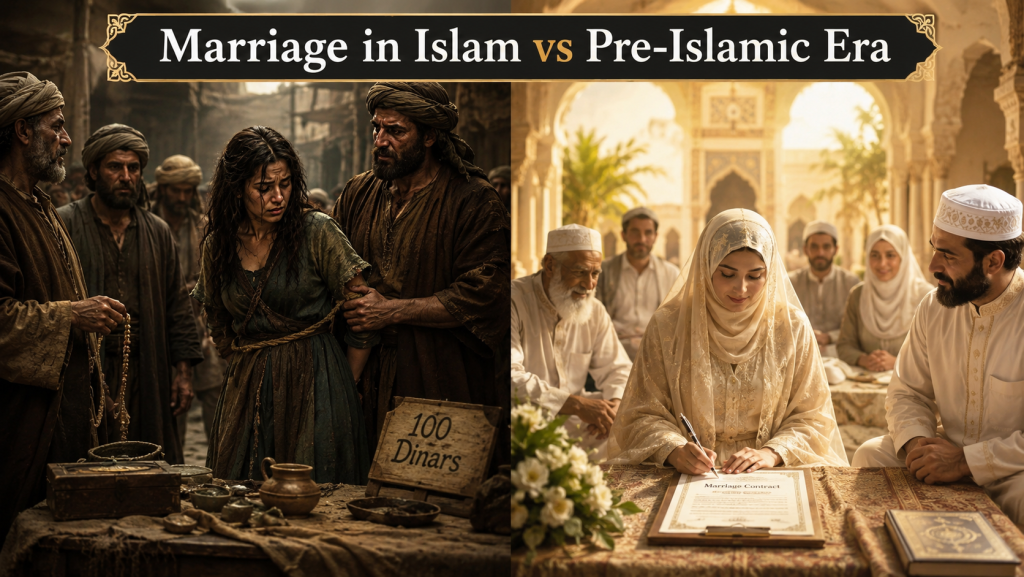
Question 1: What were the prevalent methods of marriage in the era of ignorance (Jahiliyyah)?
Answer: Marriage is an institution for the establishment and continuation of family life, but among the Arabs, it was free from rules and regulations, and there was no concept of a woman's honor, dignity, chastity, and respect involved in it. In the era of ignorance, the following methods of marriage were prevalent among the Arabs:
-
Zawaj al-Bu'ulah
Before Islam, polygyny was considered a matter of honor among the Arabs. They used to take pride in the number of women, and for this reason, this type of marriage was very common in Arabia. A man would be the owner of more than one woman. 'Bu'ulah' (being a husband) meant a man "gathering women." In this, the status of a woman was considered like ordinary property and chattels.
-
Zawaj al-Badal (Exchange Marriage)
Zawaj al-Badal, meaning marriage of exchange, referred to the mutual exchange of two wives. Meaning, two men would exchange their wives with each other, and neither would the woman have knowledge of it, nor was there any need for her acceptance, dower (Mahr), or proposal. Simply upon liking another's wife, all this would be settled in a brief gathering.
-
Nikah Mut'ah (Temporary Marriage)
This marriage would take place without a sermon (Khutbah), ceremony, and witnesses. A man and a woman would mutually agree upon a specific dower for a fixed period, and upon the completion of the fixed period, the marriage would automatically terminate; there was no need for divorce either. The couple would derive pleasure and enjoyment from each other according to their needs, and having children was not the purpose of this marriage. However, if offspring were born, they would be attributed to the mother and were not given the father's name. Islam enforced commands prohibiting Mut'ah and explicitly declared such a temporary relationship forbidden (Haram).
-
Nikah al-Khadn (Secret affair/friendship)
This is also called a marriage of friendship. In this, a man would keep a woman in his house without marriage, sermon, or dower and establish marital relations with her. Later, this relationship would end by mutual consent; no form of divorce was needed. If a child was born, they were attributed to the mother. This practice is also prevalent in contemporary Western society today.
-
Nikah al-Daghina (Marriage of the Captive)
In this marriage, there was no need for any sermon, dower, or proposal and acceptance because, in the era of ignorance, after a war, the conquered women, property, and chattels were all permissible for the victor. These women became the property of the victor; if he wished, he would sell them, if he wished, he would leave them as is, and if he wished, he would cohabit with them or give them to another person as a gift. Thus, a free woman would be sold as a slave.
-
Nikah Shighar
In this marriage, a person would marry a girl under his guardianship to another person on the condition that the latter would marry his daughter, sister, etc., to him. Fixing a dower was also not necessary in this. Islam has declared this type of marriage invalid as well.
-
Nikah al-Istibda'
A marriage of providing a woman to derive benefit, meaning a person would send his wife to spend marital life with another handsome man and stay away from her himself so that his lineage would be born beautiful and the future generation could attain health and permanence. When her pregnancy became apparent, the woman would then return to her original husband.
-
Nikah al-Rahat
Group marriage. This meant that approximately ten men would gather for a single woman, and each would cohabit with her. When she had a child, she would call all of them, and they would come without any hesitation. Then, whomever she desired (liked or considered suitable), she would tell him that this child is his, and that person was not allowed to deny it.
-
Nikah al-Baghaya
Relationship with prostitutes. This was also similar to Nikah al-Rahat, but there were two differences: First, there could be more than ten individuals in this, whereas in Nikah al-Rahat, there were no more than ten. Second, attributing the child to one of those men was not the woman's job, but the man's.
These types of marriages have been described in detail by Hafiz Ibn Hajar al-Asqalani in "Fath al-Bari Sharh Sahih al-Bukhari (Kitab al-Nikah, 9: 182-185)". Other references are as follows:
- Bukhari, As-Sahih, Kitab al-Nikah, Bab la nikah illa bi-wali, 5: 1970, No: 4834
- Abu Dawud, As-Sunan, Kitab al-Talaq, Bab fi wujuh al-Nikah, 2: 281, No: 2272
- Daraqutni, As-Sunan al-Kubra, Allati kana yatanakah biha ahl al-Jahiliyyah, 7: 110
- Bayhaqi, As-Sunan al-Kubra, 7: 110
- Qurtubi, Al-Jami' li-Ahkam al-Quran, 3: 120
Conclusion: From the aforementioned methods of marriage, it is proven and clear that in the era of ignorance, the status of a woman was like property and chattels, and she was bought and sold.
Question 2: What is the Islamic method of marriage?
Answer: The Islamic method of marriage is that the marriage (Nikah) is solemnized with the consent of a sane and mature boy and girl and in the presence of witnesses. Because Islam granted women the right to marriage, and in this marital bond, just as the personal opinion, likes, and dislikes of the man are included, the woman has also been given the right that her marriage cannot take place without her permission. As it is narrated by Hazrat Abu Hurairah (may Allah be pleased with him) that the Holy Prophet (Peace Be Upon Him) said:
لَا تُنْکَحُ الْأَيِّمُ حَتّٰی تُسْتَأْمَرَ، وَلَا تُنْکَحُ الْبِکْرُ حَتّٰی تُسْتَأْذَنَ۔ قَالُوا : یَا رَسُوْلَ اللهِ، وَکَیْفَ إِذْنُهَا؟ قَالَ : أَنْ تَسْکُتَ۔
"A widow must not be married until she is consulted, and a virgin (mature) girl must not be married until her permission is sought." The people asked: "O Messenger of Allah! How is the virgin's permission known?" He replied: "Her silence is her permission."
- Bukhari, As-Sahih, Kitab al-Nikah, Bab la yankihu al-ab wa ghayruhu al-bikr wal-thayyib illa bi-ridaha, 5: 1974, No: 4843
- Muslim, As-Sahih, Kitab al-Nikah, Bab isti'dhan al-thayyib fi al-nikah bin-nutq wal-bikr bis-sukut, 2: 1036, No: 1419
Whether an orphan, a slave-girl, or a divorced woman, they must not be deprived of the right to marriage while remaining within the rules and regulations prescribed by the Shariah, as are the Commands of Allah Almighty in the Holy Quran:
وَاِذَا طَلَّقْتُمُ النِّسَآءَ فَبَلَغْنَ اَجَلَهُنَّ فَلَا تَعْضُلُوْہُنَّ اَنْ يَّنْکِحْنَ اَزْوَاجَهُنَّ اِذَا تَرَاضَوْا بَیْنَہُمْ بِالْمَعْرُوْفِ۔
"And when you divorce women and they have [almost] reached the end of their waiting period, then do not prevent them from remarrying their [former] husbands if they agree among themselves on an equitable basis."
(Al-Baqarah, 2: 232)
وَالَّذِیْنَ یُتَوَفَّوْنَ مِنْکُمْ وَیَذَرُوْنَ اَزْوَاجًا يَّتَرَبَّصْنَ بِاَنْفُسِہِنَّ اَرْبَعَۃَ اَشْهُرٍ وَّ عَشْرًا ج فَاِذَا بَلَغْنَ اَجَلَهُنَّ فَلَا جُنَاحَ عَلَیْکُمْ فِیْمَا فَعَلْنَ فِیْ اَنْفُسِهِنَّ بِالْمَعْرُوْفِ ط وَ اللهُ بِمَا تَعْمَلُوْنَ خَبِیْرٌo
"And those of you who die and leave wives behind, they shall wait by themselves for four months and ten days. Then when they have reached their waiting period, there is no blame on you for what they do with themselves in an acceptable manner. And Allah is fully aware of what you do."
(Al-Baqarah, 2: 234)
وَاَنْکِحُوا الْاَیَامٰی مِنْکُمْ وَالصّٰلِحِیْنَ مِنْ عِبَادِکُمْ وَاِمَآئِکُمْ ط اِنْ يَّکُوْنُوْا فُقَرَآءَ یُغْنِہِمُ اللهُ مِنْ فَضْلِہٖ ط وَاللهُ وَاسِعٌ عَلِیْمٌo
"And marry those among you who are single (unmarried) and the righteous among your male and female slaves. If they are poor, Allah will enrich them out of His bounty. And Allah is All-Encompassing, All-Knowing."
(An-Nur, 24: 32)