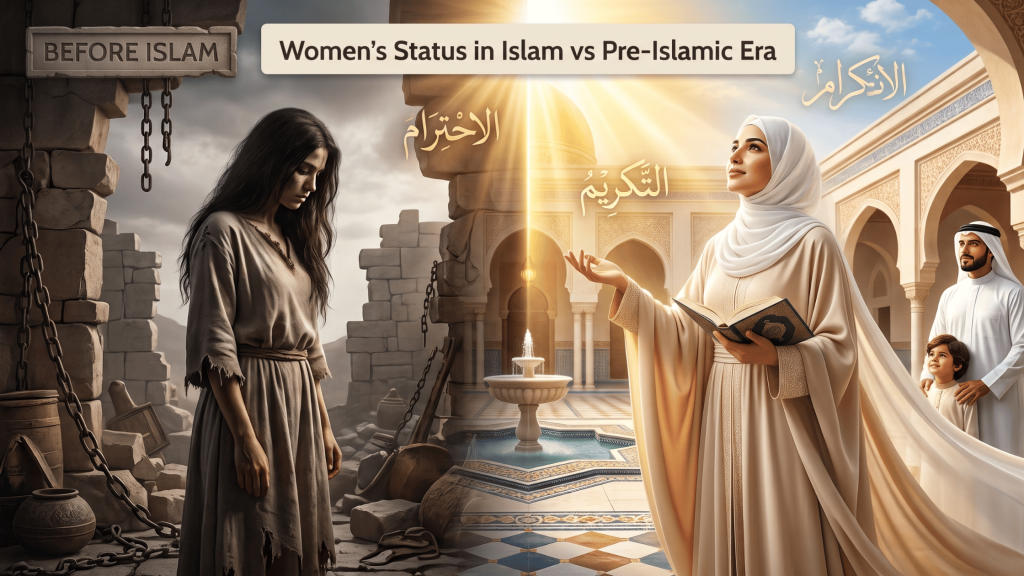
Question 1: What was the social status of women before Islam?
Answer: Before Islam, the social status of women was extremely miserable and deplorable. In human history, women and honor have been two distinctly separate realities. Women were highly oppressed and deprived of social and societal respect. They were considered the root cause of all evils and were viewed with hatred. Their status and rank were deemed undesirable. They had no rights whatsoever regarding marriage, divorce, inheritance, and other civic and social matters. A woman was helpless and powerless, unable even to make the best decision for her own life through marriage. Her opinion carried no weight in the acceptance or rejection of a marriage proposal.
This status of women was not limited only to uncivilized and uncultured nations; rather, the Greek, Roman, and Iranian nations, as well as those civilizations and cultures of the pre-Islamic era of ignorance (Jahiliyyah) that prided themselves on having reached the pinnacle of progress, treated women with the exact same attitude. Describing this appalling behavior of the Arabs towards women, Allah Almighty says in the Holy Quran:
وَیَجْعَلُوْنَ ِللهِ الْبَنَاتِ سُبْحٰنَہٗ وَلَھُمْ مَّا یَشْتَھُوْنَo
"And they assign daughters unto Allah - Exalted is He! - and for themselves what they desire (i.e., sons)."
(An-Nahl, 16:57)
Meaning, the disbelievers of Makkah held the belief that angels were the daughters of Allah, whereas they themselves disliked having daughters and only preferred sons.
- Ibn Abi Hatim Razi, Tafsir al-Quran al-Azim, 10: 3231, No: 18302
- Abu Saud, Irshad al-Aql as-Salim ila Mazaya al-Quran al-Karim, 5: 121
- Ibn Kathir, Tafsir al-Quran al-Azim, 2: 573
- Tabari, Jami al-Bayan fi Tafsir al-Quran, 14: 122-123, 126
- Tabari, Jami al-Bayan fi Tafsir al-Quran, 27: 61
- Qurtubi, Al-Jami li-Ahkam al-Quran, 10: 116
It is evident from the Holy Quran that in the era of ignorance, women had no standing; they were oppressed and persecuted, while all forms of greatness and excellence were reserved solely for men. Even in the ordinary matters of daily life, men kept the good things for themselves and gave the useless things to women. The Holy Quran describes this attitude of the Arabs as follows:
وَ قَالُوْا مَا فِیْ بُطُوْنِ ھٰذِہِ الْاَنْعَامِ خَالِصَۃٌ لِّذُکُوْرِنَا وَمُحَرَّمٌ عَلٰٓی اَزْوَاجِنَا ج وَاِنْ يَّکُنْ مَّیْتَۃً فَھُمْ فِیْہِ شُرَکَآءُ۔
"And they say: 'What is in the bellies of these cattle is exclusively for our males and forbidden to our wives. But if it is [born] dead, then all of them have shares therein.'"
(Al-An'am, 6:139)
Hazrat Abdullah bin Abbas (may Allah be pleased with them both) states in the exegesis of this verse:
فَہُوَ اللَّبَنُ، کَانُوا یُحَرِّمُونَہٗ عَلٰی إِنَاثِہِمْ، وَیَشْرَبُہٗ ذُکْرَانُہُمْ۔ وَکَانَتِ الشَّاۃُ إِذَا وَلَدَتْ ذَکَرًا ذَبَحُوہُ، وَکَانَ لِلرِّجَالِ دُونَ النِّسَاءِ۔ وَإِنْ کَانَتْ أُنْثٰی تُرِکَتْ فَلَمْ تُذْبَحْ، وَإِنْ کَانَتْ مَیْتَۃً فَہُمْ فِیہِ شُرَکَاءُ۔ فَنَہَی اللهُ عَنْ ذٰلِکَ۔
"It refers to milk, which they forbade for their females while their males would drink it. Likewise, when a sheep gave birth to a male offspring, they would slaughter it, and it would be exclusively for the men, excluding the women. If it was a female, it was left alive and not slaughtered, and if it was born dead, they were all partners in it. So, Allah forbade Muslims from doing that."
- Ibn Abi Hatim Razi, Tafsir al-Quran al-Azim, 5: 1395, No: 7933
- Tabari, Jami al-Bayan fi Tafsir al-Quran, 8: 48
- Ibn Kathir, Tafsir al-Quran al-Azim, 2: 180
- Suyuti, Ad-Durr al-Manthur fi at-Tafsir bil-Mathur, 3: 366
Abu Jafar al-Tabari has transmitted from As-Suddi in the exegesis of this verse:
فَہٰذِہِ الْأَنْعَامُ مَا وُلِدَ مِنْہَا مِنْ حَیٍّ فَہُوَ خَالِصٌ لِلرِّجَالِ دُونَ النساء، وَأَمَّا مَا وُلِدَ مِنْ مَيِّتٍ فَیَأْکُلُہُ الرِّجَالُ وَالنِّسَاءُ۔
"Whatever is born alive from these cattle is exclusively for the men, excluding the women. As for what is born dead, both men and women eat it." (In this way, they used to give preference to men).
- Ibn Abi Hatim Razi, Tafsir al-Quran al-Azim, 5: 1395, No: 7933
- Tabari, Jami al-Bayan fi Tafsir al-Quran, 8: 48
- Razi, At-Tafsir al-Kabir, 13: 171
- Abu Hayyan, Al-Bahr al-Muhit, 4: 233
- Ibn Juzayy al-Kalbi, At-Tashil li-Ulum at-Tanzil, 2: 23
Before Islam, a woman had no status. A man not only established marital relations with many women but also took pride in the mutual exchange of women, to the extent that she was deprived of inheritance and distributed like chattels in the heritage.
It is narrated by Hazrat Abdullah bin Abbas (may Allah be pleased with them both):
"When a woman's husband died, the husband's heirs would lay claim over her. If they wanted, one of them would marry her, or they would marry her off to whomever they wished, or if they wanted, they would not let her marry at all. Thus, the woman's in-laws had more right over her than her own family."
(Bukhari, As-Sahih, Kitab al-Ikrah, Bab man al-Ikrah, 6: 2548, No: 6549)
It is narrated by Hazrat Abdullah bin Abbas (may Allah be pleased with them both):
"When a person died leaving a female slave, a friend of his would throw a cloth over her, and now no other person could make a claim over this slave. If the slave was beautiful, this person would marry her, and if she was ugly, he would keep her restricted with him for life."
(Ibn Kathir, Tafsir al-Quran al-Azim, 1: 425)
Summary of Pre-Islamic Status
- Before Islam, the social status of a woman was akin to household goods.
- They treated women worse than female slaves.
- The husband held the status of a master.
- A man would tell his wedded wife to go to a certain man after attaining purity and benefit from him (conceive); the husband would remain separated from his wife for that period until the woman's pregnancy by the other man became apparent. They did this in the pre-Islamic era so that a handsome boy would be born.
- Due to widespread polygamy, there was no fixed limit on the number of wives.
- There was no determined limit on the number of marriages.
- A man would divorce whenever he wanted and as many times as he wanted, and would revoke it before the waiting period (Iddah) ended.
- Open adultery and fornication were common.
- They would even wager their women in gambling.
- They used to marry two blood sisters simultaneously.
- When a man passed away, his wives would be distributed among his offspring as inheritance.
In short: Before Islam, women faced a tragic and painful situation, from which Islam liberated them and granted them a high and exalted status in society.
Question 2: What social status did Islam grant to women?
Answer: Islam granted women an elevated and noble status in society. Extracting her from the limited sphere of various ideologies and concepts, it gave her a rank equal to men as a human being, and bestowed a great station upon her in every field of economics, society, law, politics, and education. Fourteen hundred years ago, their status, rights, and freedom were clearly determined. In fact, the practical example of Islam's vastness and open-heartedness is that it commanded every woman to be viewed through the honorable relationships of a mother, sister, and daughter, without the restriction of religion. A woman, whether Muslim or non-Muslim, can attain her rights without any discrimination.
Islam also awakened the awareness in society that if a woman is a daughter, she is a source of mercy; if she is a sister, she is a source of honor and respect; if she is a mother, Paradise lies beneath her feet; and if she is a wife, she is the embodiment of love and mercy. Thus, Islam made the respect of women mandatory in every form. For the protection of a woman's chastity and honor, it provided the foundation of such a pure marital relationship that is established while keeping in view the woman's dower (Haq Mahr), her personal likes and dislikes, and her proposal and acceptance (Ijab-o-Qabul). Furthermore, highlighting women's rights, it declared marriage with certain relatives forbidden and provided a comprehensive list of them. The Divine Command is:
حُرِّمَتْ عَلَیْکُمْ اُمَّہٰتُکُمْ وَ بَنٰتُکُمْ وَ اَخَوٰتُکُمْ وَ عَمّٰتُکُمْ وَ خٰلٰتُکُمْ وَ بَنٰتُ الْاَخِ وَ بَنٰتُ الْاُخْتِ وَ اُمَّهٰتُکُمُ الّٰتِیْ اَرْضَعْنَکُمْ وَ اَخْوٰتُکُمْ مِّنَ الرَّضَاعَۃِ وَ اُمَّهٰتُ نِسَآئِکُمْ وَرَبَآئِبُکُمُ الّٰتِیْ فِیْ حُجُوْرِکُمْ مِّنْ نِّسَآئِکُمُ الّٰتِیْ دَخَلْتُمْ بِہِنَّ ز فَاِنْ لَّمْ تَکُوْنُوْا دَخَلْتُمْ بِہِنَّ فَلَا جُنَاحَ عَلَیْکُمْ ز وَحَلَآئِلُ اَبْنَائِکُمُ الَّذِیْنَ مِنْ اَصْلَابِکُمْ لا وَ اَنْ تَجْمَعُوْا بَیْنَ الْاُخْتَیْنِ اِلَّا مَا قَدْ سَلَفَ۔
"Prohibited to you [for marriage] are your mothers, your daughters, your sisters, your father's sisters, your mother's sisters, your brother's daughters, your sister's daughters, your [milk] mothers who nursed you, your sisters through nursing, your wives' mothers, and your step-daughters under your guardianship [born] of your wives unto whom you have gone in. But if you have not gone in unto them, there is no sin upon you. And [also prohibited are] the wives of your sons who are from your [own] loins, and that you take [in marriage] two sisters simultaneously, except for what has already occurred."
(An-Nisa, 4:23)
Islam eradicated all those abhorrent customs that were contrary to a woman's human dignity and granted women those rights which made them deserving of honor and respect in society. The Holy Prophet (Peace Be Upon Him) encouraged good treatment of women to such an extent that he declared it an essential component of a supreme virtue like faith. It is narrated by Hazrat Abu Hurairah (may Allah be pleased with him) that the Holy Prophet (Peace Be Upon Him) said:
أَکْمَلُ الْمُؤْمِنِینَ إِیمَانًا أَحْسَنُہُمْ خُلُقًا وَخِیَارُکُمْ خِیَارُکُمْ لِنِسَائِکُمْ۔
"The most perfect of the believers in faith is the one with the best character among them, and the best of you are those who are best to their wives (in character and conduct)."
- Ahmad bin Hanbal, Al-Musnad, 2: 621, No: 8: 1011
- Tirmidhi, As-Sunan, Kitab ar-Rada, Bab ma ja'a fi haqq al-mar'ah ala zawjiha, 3: 466, No: 1162
- Darimi, As-Sunan, 2: 415, No: 2792
- Hakim, Al-Mustadrak, 1: 43, No: 2
In one narration, Hazrat Aisha Siddiqah (may Allah be pleased with her) states that the Holy Prophet (Peace Be Upon Him) said:
إِنَّ مِنْ أَکْمَلِ الْمُؤْمِنِینَ إِیمَانًا أَحْسَنُہُمْ خُلُقًا وَأَلْطَفُهُمْ بِأَہْلِہٖ۔
"Among the believers, the ones with the most perfect faith are those who have the best character and who are the kindest and most affectionate towards their families."
- Ahmad bin Hanbal, Al-Musnad, 6: 47, No: 24250
- Tirmidhi, As-Sunan, Kitab al-Iman, Bab ma ja'a fi istikmal al-iman wa ziyadatihi wa nuqsanihi, 5: 9, No: 2612
- Nasai, As-Sunan al-Kubra, 5: 364, No: 9154
- Hakim, Al-Mustadrak, 1: 119, No: 173